AI-Powered SOC: How Modern Security Teams Deal with Alert Fatigue
Cybersecurity Insights
Oleh Cisometric, Diterbitkan pada November 26, 2025
Security Operations Centers (SOCs) were built to detect threats quickly. But in reality, many are now overwhelmed by something else, alert fatigue.
Across industries, security teams are dealing with thousands of alerts per day, a high percentage of which are false positives or low-priority events. This constant noise makes it harder to identify the few alerts that truly matter, increases operational risk, and contributes to analyst burnout (Cyber Sierra, 2025; Cymulate, 2024).
In this article, we look at what alert fatigue is, why it happens, and how AI-powered SOCs, combined with SOAR and strong human processes, can help organizations regain control.
What Is Alert Fatigue?
Alert fatigue is the condition that occurs when security teams are exposed to a continuous stream of threat alerts, to the point where they become desensitized. When almost everything is flagged as “suspicious,” the ability to distinguish between genuine threats and harmless noise is significantly reduced (Cyber Sierra, 2025).
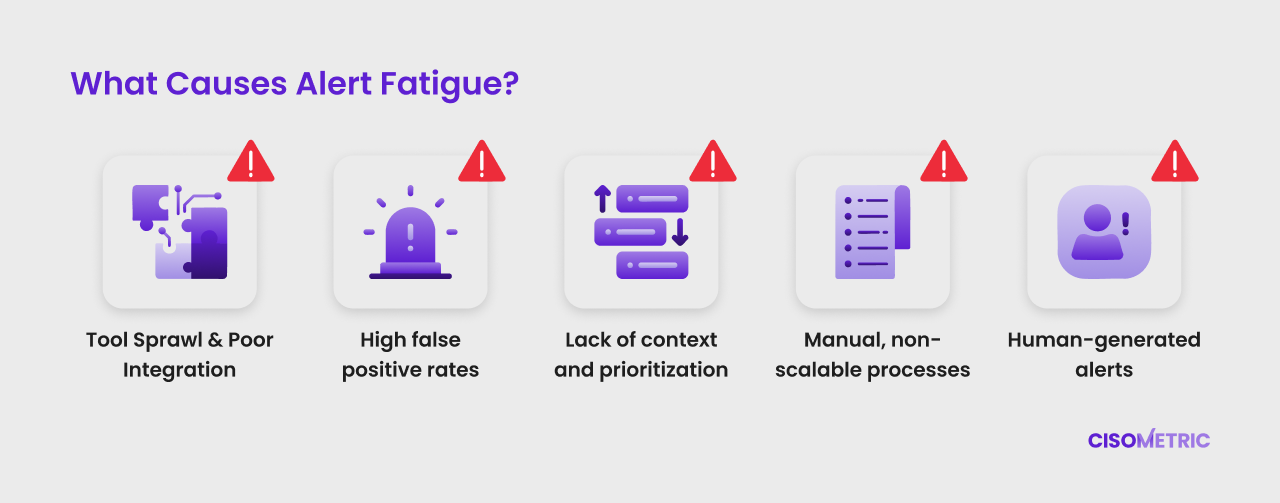
Tool sprawl is the accumulation of many IT tools, often for similar or overlapping purposes, which can lead to inefficiencies, increased costs, and data silos.
Modern organizations often deploy dozens of security products like SIEM, EDR/XDR, IDS/IPS, cloud security tools, vulnerability scanners, and more. Each tool generates its own alerts. Without strong integration and correlation, a single security event can trigger multiple, overlapping alerts (Cymulate, 2024).
2. High false positive rates
Default detection rules are often overly sensitive. If these rules are not regularly tuned and validated, they will generate large volumes of false positives. Over time, analysts lose confidence in the alerting system and may unconsciously start to ignore or quickly dismiss notifications (Cyber Sierra, 2025).
3. Lack of context and prioritization
Generic alerts such as “suspicious activity detected” provide limited guidance. When alerts lack context (such as asset criticality, user role, or associated threat intelligence) analysts must manually gather information from multiple systems. This slows down triage and makes every alert feel equally urgent, even when it is not (Right-Hand Cybersecurity, 2024).
4. Manual, non-scalable processes
In many SOCs, triage, enrichment, and escalation are still handled manually. This approach does not scale in an environment where alert volumes are growing and attack surfaces are expanding due to cloud adoption, remote work, and third-party integrations (BBC, 2025).
5. Human-generated alerts (the human factor)
A significant proportion of SOC alerts originate from user behavior:
Employees clicking phishing links
Use of unauthorized applications or shadow IT
Misconfiguration or mishandling of sensitive information
Research suggests that a large majority of attacks start with people, which means a large share of alerts is driven by preventable human error (Right-Hand Cybersecurity, 2024).
Alert fatigue has direct implications for business risk, regulatory exposure, and workforce sustainability, such as:
1. Missed or delayed detection
When analysts are overloaded, genuine threats are more likely to be missed or investigated too late.
Historical breaches, such as the Target incident in 2013, showed that critical alerts were generated but buried in a mass of notifications (Cymulate, 2024). The tools were functioning but the challenge was the human capacity to act on the signals.
2. Increased dwell time and business impact
Longer Mean Time to Detect (MTTD) and Mean Time to Respond (MTTR) allow attackers more time to move laterally, escalate privileges, and exfiltrate data. This directly increases the potential financial and reputational impact of incidents (BBC, 2025).
3. Analyst burnout and turnover
Continuous exposure to high alert volumes and constant pressure can lead to stress, fatigue, and burnout among security professionals. Several surveys indicate that alert overload is a key contributor to cybersecurity staff considering career changes (Channel News Asia, 2024).
High turnover, in turn, weakens institutional knowledge and creates a negative cycle for SOC performance.
4. Erosion of trust in security tools
If analysts perceive most alerts as noise, they may begin to distrust the tools and deprioritize certain alerts without proper investigation. This undermines the value of significant investments in security technologies (Cox, 2023).
How AI-Powered SOCs Help Reduce Alert Fatigue
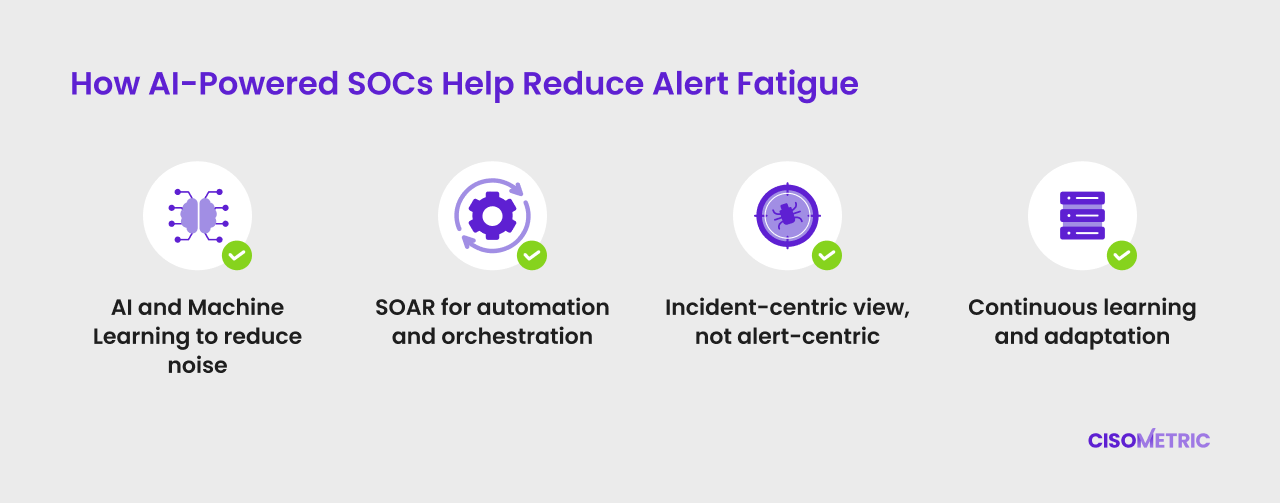
Addressing alert fatigue requires a combination of technology, process, and people. One of the most effective approaches emerging today is the AI-powered SOC, which is the type of SOC that integrates SIEM/XDR, SOAR, AI, and machine learning in a tightly orchestrated way.
Security Orchestration, Automation, and Response (SOAR) platforms help automate repetitive tasks such as:
Initial triage and classification
Automated data enrichment (e.g., IP reputation, geo-location, asset data)
Executing standard response playbooks (block, isolate, reset, notify, etc.)
This reduces manual workload and allows analysts to focus on higher-value investigations (Cymulate, 2024).
3. Incident-centric view, not alert-centric
Instead of treating every alert as a separate item, AI-powered SOCs group related events into a single incident view.
Correlation engines connect activities by user, asset, network segment, or attack technique. This shift from alert-centric to incident-centric operations dramatically improves readability and reduces duplication.
4. Continuous learning and adaptation
With AI and ML, detection capabilities can evolve along with the environment and threat landscape. As the model learns from analyst feedback, known-good behavior, and newly observed attack patterns, the quality of alerts improves over time (BBC, 2025).
Conclusion
Alert fatigue has become one of the most persistent obstacles in modern security operations. With cyber threat alert volumes growing and environments becoming more complex, traditional SOC approaches are no longer sufficient to maintain visibility, speed, and accuracy.
By adopting an AI-powered SOC, organizations can significantly reduce noise, improve detection quality, and allow analysts to focus on genuine threats. Moving from alert-centric to incident-centric operations creates a more efficient workflow, while continuous learning ensures the system evolves alongside the threat landscape.
Cisometric’snext-generation AI-Powered SOC is designed to help organizations overcome alert fatigue with intelligent automation, advanced threat correlation, and 24/7 expert monitoring.
If your team is experiencing rising alert volumes, missed signals, or operational strain, it may be time to modernize your SOC capabilities. Discover how Cisometric can strengthen your defenses and reduce alert fatigue safely, efficiently, and at scale. Contact us to learn more about how our SOC can support your organization’s security operations.
Schedule a free consultation with our experts today, click here.
For more updates on digital scams, cybersecurity insights, and expert tips, follow our social media:
Kami menggunakan cookie untuk meningkatkan pengalaman menjelajah, menganalisis lalu lintas situs, dan menyajikan konten yang relevan. Pilih cookie mana yang Anda izinkan.
Kebijakan Privasi