
By Patricia A. Pramono • Studio 1080, Published on June 22, 2026
TABLE OF CONTENTS
There was a time when cyberattacks were easier to spot, in the form of a suspicious email, a malicious document attachment, a strange-looking link, or malware quietly entering a system.
Today, it is far more complicated.
A phishing email can now be written with near-perfect grammar, a fake executive voice can sound familiar enough to trigger trust, a deepfake video call can look convincing enough to authorize a financial transfer. In one widely reported case, fraudsters used AI-generated deepfakes to trick an employee at an engineering firm into transferring USD 25 million (WEF, 2025).
Also read: Phishing: New Methods and How to Stay Safe
The ability of an organization detecting malware is no longer enough. Can modern organizations understand what is happening fast enough, across all the signals, systems, identities, and behaviors that make up today’s digital attacks and cyber environments? That is the bigger question.
This is where Security Operations Centers, or SOCs, need to evolve.
AI is now becoming part of the cyberattack surface. AI has brought major opportunities for cybersecurity. It can help detect anomalies, prioritize alerts, automate repetitive tasks, and support faster investigations.
But the same technology is also changing how attackers operate.
In 2026, ESET announced a €40 million investment into AI-powered cybersecurity, including the development of a new generation of AI SOC technologies. The announcement came with a clear warning, that autonomous and agentic AI systems are creating a rapidly expanding attack surface.
One of ESET’s findings is especially worth paying attention to. Since March 2026, ESET technologies scanned nearly 800,000 unique AI Skills, which are modular components that instruct AI agents how to perform tasks, use tools, access services, and interact with external systems. Around 25,000 were flagged as suspicious, and more than 3,000 were blocked as malicious.
AI is no longer sitting outside the business, it is being connected to workflows, applications, repositories, datasets, and third-party services. In other words, AI is becoming part of how businesses work, and when something becomes part of how businesses work, it also becomes something attackers will try to exploit.
CrowdStrike’s 2026 Global Threat Report found that the average eCrime breakout time dropped to just 29 minutes in 2025, while attacks from AI-enabled adversaries increased by 89%. The same report also noted that 82% of detections were malware-free, showing that attackers are increasingly relying on identity abuse, legitimate tools, and hands-on-keyboard activity instead of traditional malware.
For business leaders, this means, cyber threats are becoming faster, more believable, and harder to separate from normal activity.
The problem with traditional SOC models
A traditional Security Operations Center (SOC) is designed to monitor, detect, investigate, and respond to cybersecurity threats. It is a critical part of an organization’s defense, but the environment around SOC teams has changed dramatically.
Today, security teams are dealing with more:
- Endpoints
- Cloud environments
- SaaS applications
- Identities
- Third-party integrations
- Compliance requirements
- Alerts
The issue is not that organizations lack data. Many organizations have too much of it.
Logs, alerts, telemetry, network activity, user behavior, endpoint signals, threat intelligence feeds, cloud events, access attempts, all of these can produce valuable security signals. However, when they are fragmented across different tools and dashboards, it becomes difficult for analysts to see the full picture quickly.
This is where security operations often get stuck. A team may have alerts, but not enough context. They may have dashboards, but not enough correlation. They may have tools, but not enough time to investigate every signal manually.
Attackers know this. Modern attacks often succeed not because there was no signal, but because the signal was missed, delayed, misclassified, or buried under noise.
So, how can a SOC move from simply collecting alerts to actually understanding what matters?
What is an AI-powered SOC?
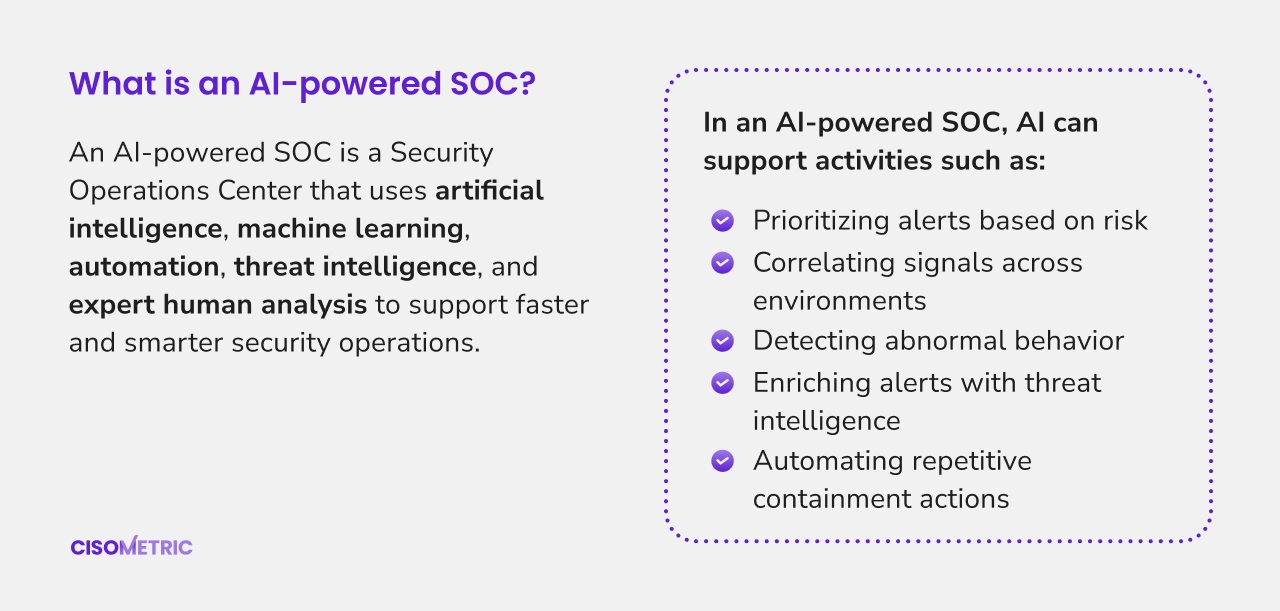
An AI-powered SOC is a Security Operations Center that uses artificial intelligence, machine learning, automation, threat intelligence, and expert human analysis to support faster and smarter security operations.
However, it is important to note that AI-powered SOC does not mean replacing security analysts with AI agents.
A better way to understand it is that AI helps analysts process more information, reduce repetitive work, detect patterns faster, and focus on the threats that matter most.
In an AI-powered SOC, AI can support activities such as:
- Filtering and prioritizing alerts based on risk
- Correlating signals across endpoint, network, cloud, identity, and application environments
- Detecting abnormal user or system behavior
- Enriching alerts with threat intelligence
- Summarizing investigation context
- Recommending response steps based on playbooks
- Automating repetitive containment actions under defined rules
Modern cybersecurity environments are increasingly complex. Manual monitoring alone is no longer sufficient to manage the speed, scale, and sophistication of today’s threats.
ESET’s AI cybersecurity investment also highlights several benefits of AI in cybersecurity, including faster threat detection, improved accuracy when AI is trained on cybersecurity-specific data, and better scalability for complex security environments (Dr. Matthew Lynch, 2026).
However, human expertise remains essential.
AI can accelerate analysis, surface patterns, and recommend actions, but cybersecurity decisions still require validation, business context, risk assessment, and accountability. The strongest SOC model is not AI replacing analysts. It is AI supporting analysts so they can make faster and better-informed decisions.
How AI-powered SOC creates business value
For business leaders, AI-powered SOC should not be viewed only as a technical enhancement. It is a strategic capability that supports cyber resilience, operational continuity, and risk management.
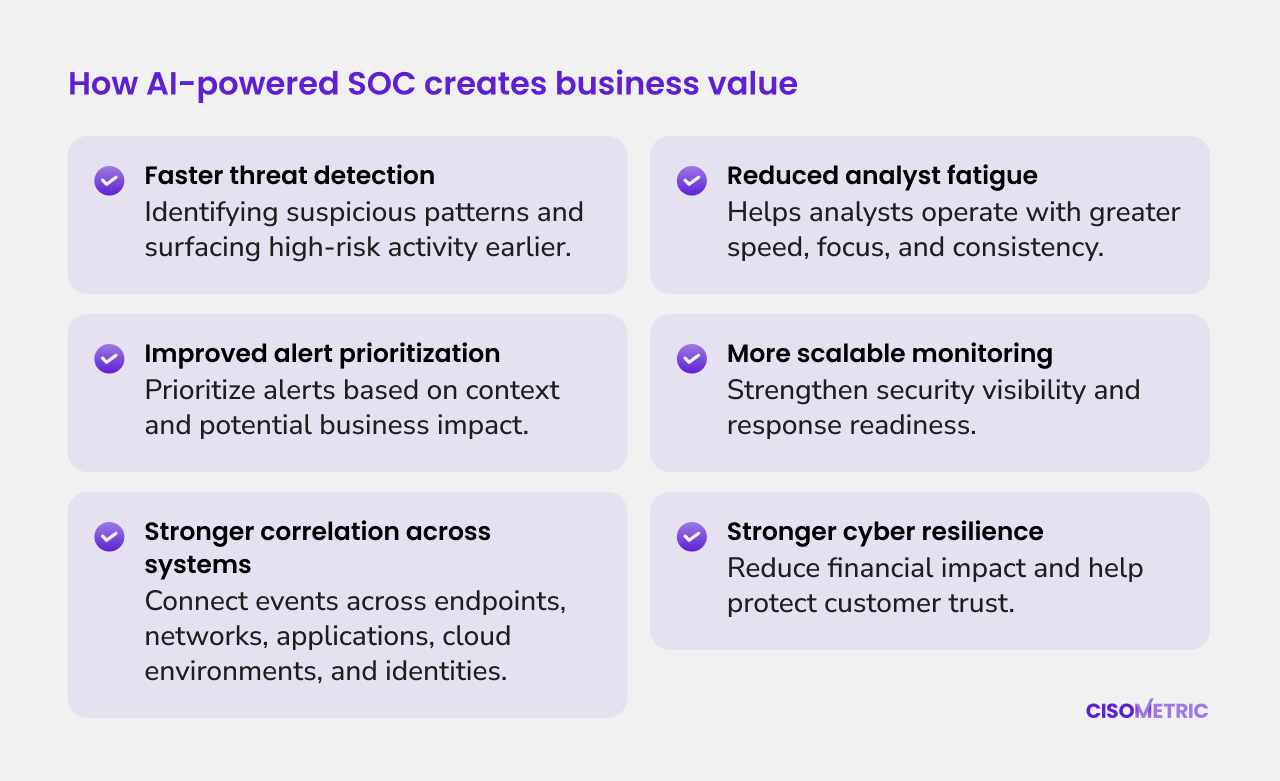
Here are several ways AI-powered SOC can create value for businesses:
1. Faster threat detection
In cybersecurity, response time can determine the scale of impact.
The longer an attacker remains undetected, the greater the opportunity to move laterally, escalate privileges, access sensitive data, disrupt operations, or prepare a ransomware attack.
AI-powered SOC helps improve detection speed by analyzing large volumes of telemetry, identifying suspicious patterns, and surfacing high-risk activity earlier. This allows security teams to move faster from signal identification to investigation and response.
For organizations, faster detection is not only a security advantage. It can also reduce potential downtime, operational disruption, and financial exposure.
2. Improved alert prioritization
Not every alert carries the same level of risk. Some alerts are low priority. Some are false positives. Some are early indicators of a serious incident. When analysts are required to review every alert manually, critical signals can be delayed or missed.
AI-powered SOC can help prioritize alerts based on context, such as asset criticality, user behavior, severity, threat intelligence, and potential business impact. This enables analysts to focus first on the incidents that require immediate attention.
Better prioritization helps reduce alert fatigue and improves the overall efficiency of security operations.
3. Stronger correlation across systems
Modern attacks rarely occur in one isolated system.
A single incident may involve a compromised identity, an endpoint alert, unusual network traffic, suspicious file activity, and abnormal cloud access. Viewed separately, these signals may not appear critical. Viewed together, they may reveal an active attack path.
AI-powered SOC supports stronger correlation across different data sources. It helps connect events across endpoints, networks, applications, cloud environments, and identities, giving analysts a clearer view of how an incident is developing.
This level of correlation is especially important as organizations adopt more cloud services, remote access, third-party platforms, and digital workflows.
4. Reduced analyst fatigue
Security analysts are often challenged by high alert volumes and repetitive investigation tasks. This can reduce efficiency and increase the risk of missing important signals.
AI can help reduce repetitive workloads by grouping related alerts, enriching context, summarizing activity, and automating predefined response workflows. This allows analysts to spend more time on higher-value work, such as validation, threat hunting, impact assessment, and response strategy.
In this way, AI does not replace the analyst, but rather helps analysts operate with greater speed, focus, and consistency.
Also read: AI-Powered SOC: How Modern Security Teams Deal with Alert Fatigue
5. More scalable monitoring
Not every organization has the resources to build and maintain a full in-house SOC. For many businesses, 24/7 security monitoring requires significant investment in people, tools, processes, and expertise.
AI-powered SOC makes continuous monitoring more scalable by combining automation, machine learning, threat intelligence, and expert-led operations. This enables organizations to strengthen security visibility and response readiness without carrying the full complexity of building everything internally.
This is particularly relevant for growing companies and mid-sized organizations that need stronger cybersecurity capabilities but may not have the capacity to operate a mature SOC on their own.
6. Stronger cyber resilience
Cybersecurity is not only about preventing incidents. It is also about limiting the impact when incidents occur.
IBM’s 2025 Cost of a Data Breach Report found that organizations using AI and automation extensively across security operations saved an average of USD 1.9 million in breach costs and reduced the breach lifecycle by an average of 80 days (IBM, 2025).
This shows that AI-powered security operations can provide measurable business value. Faster detection, better investigation, and more efficient response can support operational continuity, reduce financial impact, and help protect customer trust.
For business leaders, all of these make AI-powered SOC not only a cybersecurity investment, but also a resilience investment.
AI-powered SOC still requires governance
Although AI can improve security operations, it must be implemented with proper supervision and management.
AI systems can support analysis and automation, but they should not operate without clear boundaries. Organizations need to define how AI is used, what data it can access, when automation is allowed, and when human approval is required.
For SOC operations, governance may include approved AI use cases, access controls, data handling rules, human validation for critical decisions, audit trails for AI-assisted workflows, and regular review of automation playbooks.
The objective is to ensure that AI strengthens security operations without introducing unmanaged risk. A mature AI-powered SOC must therefore combine three elements: advanced technology, human expertise, and clear governance.
Also read: Understanding AI Governance: Risks, Rules, and Best Practices
Strengthening security operations with Cisometric AI-Powered SOC
As AI-driven cyber threats grow and security environments become more complex, organizations need security operations that can support faster detection, stronger visibility, and more effective response.
Cisometric’s Security Operations Center is designed as an AI-powered and expert-driven security operations capability. It combines 24/7/365 monitoring, AI and machine learning, real-time threat detection, rapid incident response, and continuous improvement to help organizations strengthen resilience, compliance, and business continuity.
Cisometric SOC is supported by key capabilities such as Comprehensive Threat Monitoring, Security Orchestration, Automation, and Response, Threat Intelligence Platform, custom use cases and playbooks, Network Detection and Response, File Integrity Monitoring, proactive threat hunting, rapid incident response, compliance support, and continuous improvement.
Also read: What is File Integrity Monitoring in SOC?
Through these capabilities, businesses can improve visibility across systems, networks, endpoints, applications, and cloud environments. They can also strengthen response readiness, reduce operational blind spots, and support compliance with evolving cybersecurity requirements.
With Cisometric AI-Powered SOC, organizations can strengthen visibility, accelerate detection, improve response readiness, and build a more resilient cybersecurity foundation for the future.
For more updates on cybersecurity insights, follow our social media:
LinkedIn: Cisometric
Instagram: @cisometric
Youtube: @Cisometric


