
MITRE ATT&CK Framework: Arsitektur Deteksi dan Cara Mengukur Cakupan SOC yang Sebenarnya
Panduan arsitektur deteksi MITRE ATT&CK framework, distribusi 15 taktik, logika korelasi SIEM, dan cara mengukur efektivitas cakupan SOC yan...

Oleh Cisometric Marketing Team, Diterbitkan pada Januari 6, 2026
GitHub has long been seen as a safe space for collaboration, learning, and experimentation. For developers, security professionals, and students alike, it’s often the first place to look when researching vulnerabilities, proof-of-concept (PoC) exploits, or new tools.
But what happens when that trust is quietly weaponized?
In early 2025, security researchers uncovered a growing malware campaign involving WebRAT in GitHub, a remote access trojan that has evolved far beyond its original targets. What started as a threat aimed at gamers is now reaching deeper, into developer communities, open-source platforms, and even early-career cybersecurity professionals (Securelist, 2025; CSO Online, 2025).
This shift signals something bigger than just another malware variant. It highlights how open platforms and professional curiosity themselves have started becoming attack surfaces as well.
Also read: Understanding Malware Threats
WebRAT first appeared around January 2025, initially spreading through fake game cheats, cracked software, and pirated tools for popular titles like Rust, Counter-Strike, and Roblox (Cybersecurity News, 2025).
Users searching for shortcuts were more likely to ignore warnings, and this is what they’re targeting.
But by September 2025, researchers observed a notable change. The attackers widened their net, repackaging WebRAT as proof-of-concept exploits and security tools, and hosting them on platforms such as GitHub (Securelist, 2025).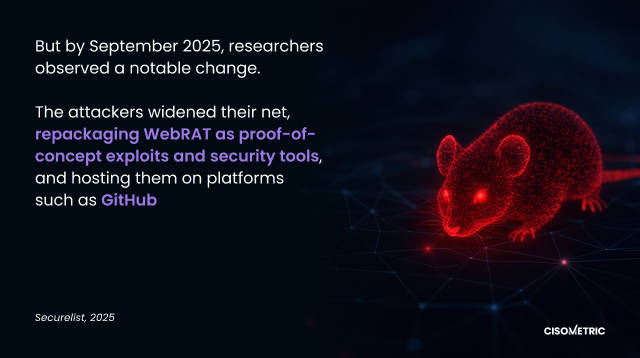
Instead of targeting casual gamers, the new lures were designed for:
In other words, people who are supposed to be cautious, but may still trust what looks familiar.
In cybersecurity, a proof-of-concept (PoC) exploit is a piece of code created to demonstrate that a vulnerability is real and exploitable. Its purpose is not to cause harm, but to show security teams, developers, or researchers what could go wrong if a flaw is left unpatched.
PoCs are commonly shared on open platforms like GitHub as part of responsible disclosure, research, or education. They help organizations understand risk, prioritize fixes, and improve defenses (VulnCheck, 2025).
That trust, however, is exactly what attackers are exploiting.
By disguising malware as PoC exploits, threat actors take advantage of the assumption that research code is safe to download and test. For inexperienced users, students, or professionals working outside isolated environments, a fake PoC can quickly turn curiosity into compromise.
WebRAT’s real strength lies in social engineering. Attackers carefully crafted GitHub repositories that look convincing at first glance. Many include:
Security researchers noted that many of these descriptions follow a consistent structure and wording, strongly suggesting they were machine-generated to appear authoritative and polished (Securelist, 2025).
To reinforce credibility, attackers also turned to YouTube. They uploaded tutorial-style videos demonstrating how to download and run the supposed tools, then placed malicious links in the video descriptions or comment sections (Cybersecurity News, 2025).
The result is a seamless illusion of legitimacy (ranging from documentation to walkthroughs) all designed to lower suspicion.
How WebRAT Actually Operates
The success of this campaign makes more sense once we understand what attackers are pretending to offer.
Many of the malicious files distributed in this campaign are disguised as PoC exploits.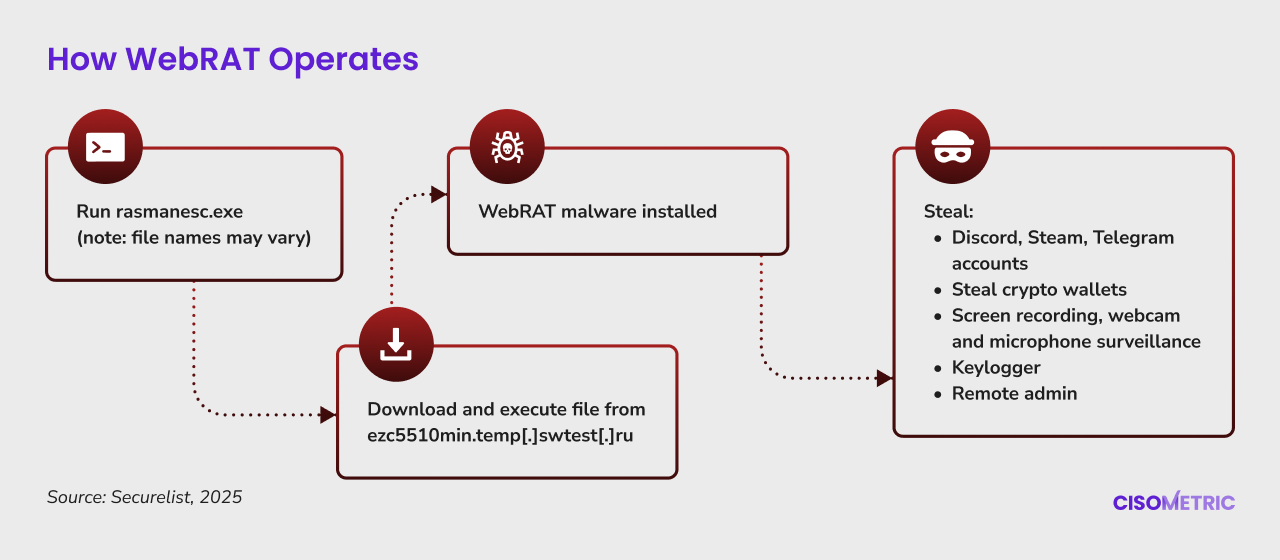
By presenting WebRAT as a PoC, complete with detailed documentation, vulnerability descriptions, and step-by-step guides, the files appear educational rather than dangerous. For users who follow the instructions without testing the code in isolated environments, execution happens quickly and quietly.
Once downloaded and run, the exploit reveals its real purpose.
WebRAT installs itself as a full-featured backdoor, giving attackers deep and persistent access to the infected system. Researchers found that it can extract credentials from platforms such as Steam, Discord, Telegram, and cryptocurrency wallets, while also performing surveillance activities like keystroke logging, screen recording, and access to webcams and microphones (Securelist, 2025; CSO Online, 2025).
In several observed cases, the malware was delivered through password-protected ZIP files, with the password subtly hidden inside file names, an easy detail to overlook when users are following what looks like legitimate technical documentation.
Beyond immediate data theft, WebRAT enables attackers to deploy additional malicious payloads, ranging from crypto-miners to further spyware.
What Organizations and Professionals Should Do to Stay Safe
At first glance, WebRAT might seem like an individual-level threat. But the implications go much further. Employees who download pirated software or experiment with unverified tools on work devices can unknowingly expose:
Because WebRAT enables persistent remote access, attackers may quietly move laterally within corporate environments, well beyond the original infected device (Cybersecurity News, 2025).
In this context, one careless download can become an organizational incident. Some practical takeaways for organizations and professionals, include:
Ultimately, WebRAT isn’t just about malware, it’s also about how human behavior, platform trust, and social engineering intersect.
Also read: What Is Social Engineering?
WebRAT is not the most technically advanced malware we’ve seen, but what makes it especially effective is how it blends into environments we trust.
Open platforms like GitHub and YouTube are designed to encourage learning and collaboration. Proof-of-concept exploits are meant to educate, not infect. Yet in this case, that was repurposed as a malware delivery mechanism.
The takeaway is not to stop learning, sharing, or experimenting. It’s to recognize that human behavior and curiosity are now central to cyber threats. Malware no longer relies solely on exploiting systems, it increasingly exploits human behavior.
For organizations, security risks don’t always come from obvious red flags. Sometimes, they arrive as well-written documentation, helpful tutorials, or research codes downloaded with good intentions.
This is why modern cybersecurity can’t rely on prevention alone. Visibility, behavioral monitoring, and the ability to detect unusual activity early are critical. At Cisometric, this is exactly the risk landscape we help organizations navigate.
Through continuous monitoring, threat intelligence, and incident response readiness, we work with teams to detect threats that slip past traditional defenses, especially those hiding in plain sight.
Schedule a free consultation with our experts today, click here.
For more updates on digital scams, cybersecurity insights, and expert tips, follow our social media:
LinkedIn: Cisometric
Instagram: @cisometric
Youtube: @Cisometric
Reference:
WebRAT Malware via GitHub Repositories Claim as Proof-of-concept Exploits to Attack Users
Panduan arsitektur deteksi MITRE ATT&CK framework, distribusi 15 taktik, logika korelasi SIEM, dan cara mengukur efektivitas cakupan SOC yan...

Cybersecurity sering kali dibahas dari sisi teknologi, mulai dari sistem yang lebih kuat, kemampuan deteksi yang lebih baik, otomatisasi yan...

A phishing email can now be written with near-perfect grammar, a fake executive voice can sound familiar enough to trigger trust,
Cari Artikel Berdasarkan Kategori
Kami menggunakan cookie untuk meningkatkan pengalaman menjelajah, menganalisis lalu lintas situs, dan menyajikan konten yang relevan. Pilih cookie mana yang Anda izinkan. Kebijakan Privasi