In early November 2025, LinkedIn implemented a major policy change with substantial implications for professionals and organizations worldwide. As of 3 November 2025, the platform is now using user data to train its generative AI models, and this feature is turned on by default (LinkedIn, 2025).
Initially, this update only affected LinkedIn users in the EU, EEA, Switzerland, Canada, and Hong Kong. However, LinkedIn has now extended this rollout to more regions, including Indonesia.
This means that Indonesian users’ data may already be included in LinkedIn’s AI training pipeline unless they manually opt out.
While LinkedIn positions this as an enhancement to user experience and job-matching capabilities, it has raised questions around transparency, data control, and the long-term impact on digital privacy.
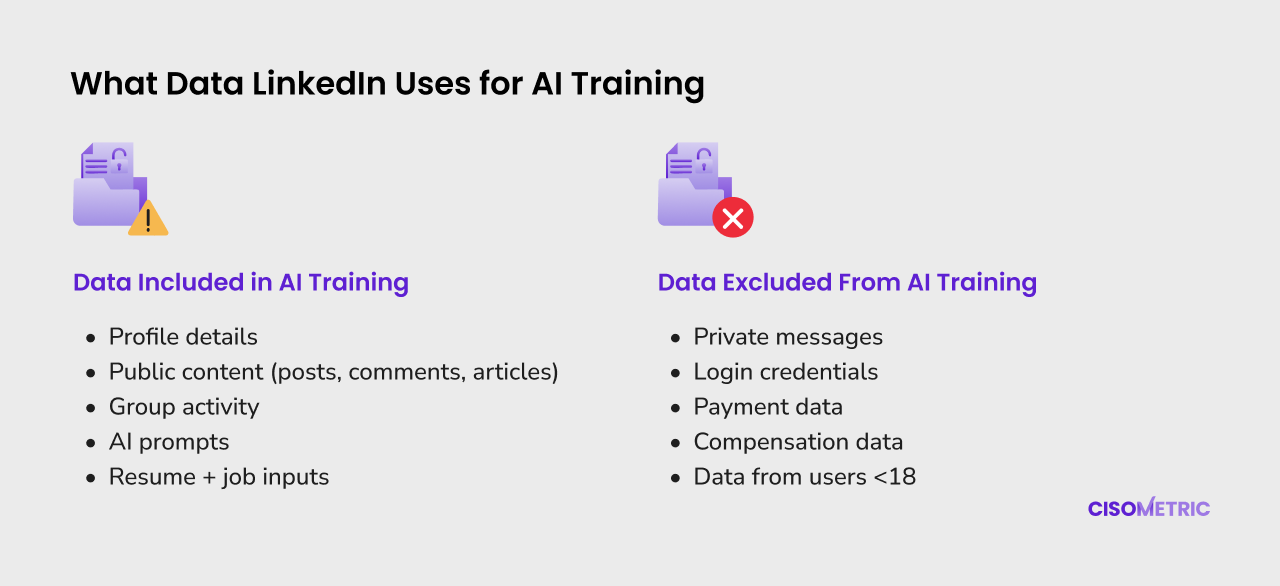
Public content: Posts, articles, comments, poll responses, and public discussions
Groups activity: Public group participation and group messages
Generative AI interactions: Prompts or content entered into LinkedIn’s AI features
Jobs-related inputs: Resumes and non-sensitive screening question responses
This effectively means that much of the content professionals actively share on the platform may now contribute to LinkedIn’s internal AI development.
Data Excluded From AI Training
LinkedIn states that the following will not be used (NK, 2025):
Private messages
Login and credential information
Payment data
Sensitive compensation or application data identifiable to individuals
Data from users under 18
While these exclusions are reassuring, the scope of data being captured remains significant, given how much professional identity and career-related content is openly shared on the platform.
The good news is, LinkedIn provides an opt-out mechanism, though users must actively locate and update their settings.
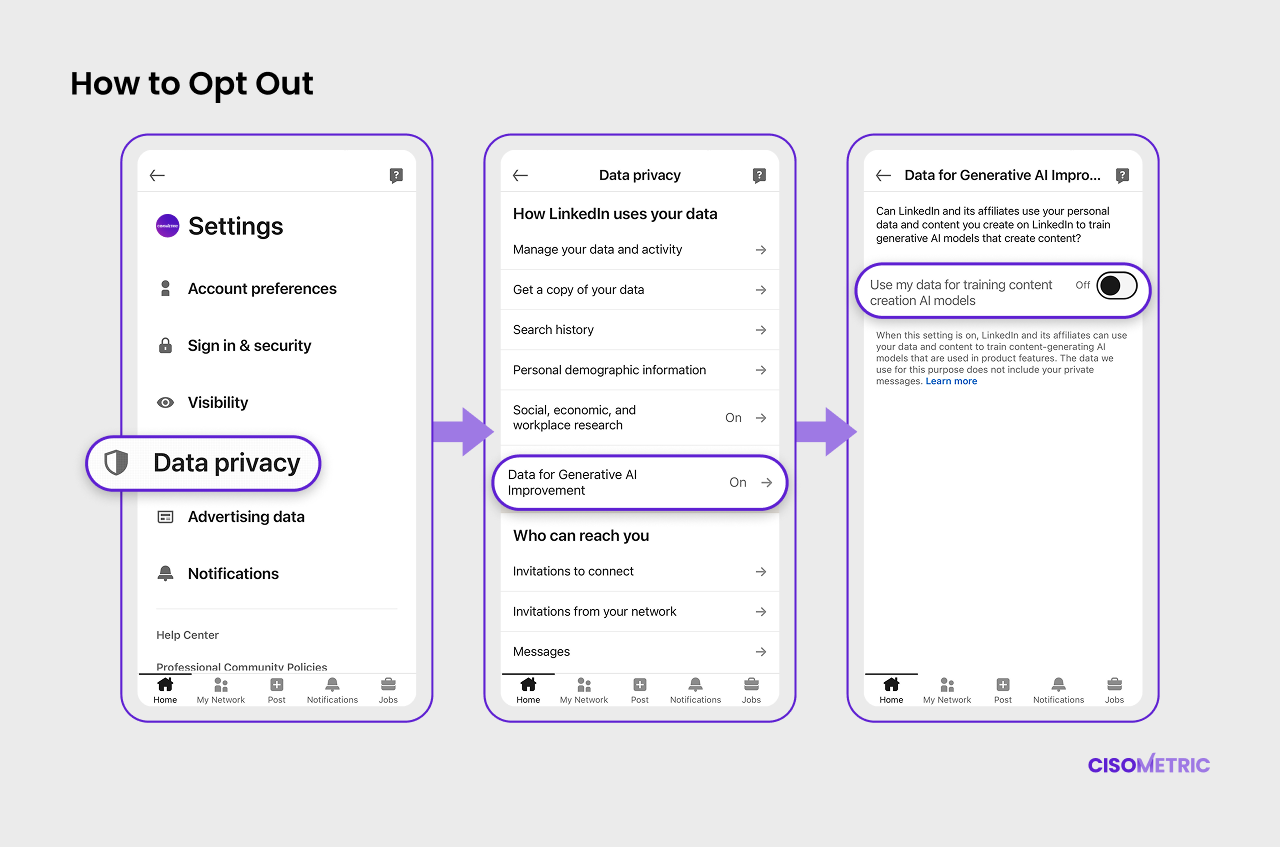
Steps to opt out:
Navigate to Settings & Privacy
Select Data Privacy
Choose Data for Generative AI Improvement
Toggle the setting Off
Once disabled, your future data should no longer be used for AI training (PCMag, 2025). However, LinkedIn’s policy encourages users to periodically review their settings as terms may evolve.
How Social Media Platforms Use User Data for AI Training
LinkedIn is not the only one. Across the industry, major social platforms, including Meta, X, and Reddit, are leveraging user-generated content to train AI models (Machaiah, 2025). This trend reflects several underlying dynamics:
1. Large-scale data collection
User posts, reactions, comments, images, and interactions supply the raw data needed to teach AI to understand language, behavior, and patterns.
2. Model development and recommendation systems
Social media data enables:
More accurate job recommendations
Better content suggestions
Enhanced relevance in advertisements
Improved generative AI outputs
3. Sharing with affiliates and partners
LinkedIn confirms that it may share certain data with its affiliate companies, including Microsoft and its subsidiaries, for AI and advertising-related purposes (LinkedIn, 2025).
While these applications can offer improved user experience, they raise important questions around transparency, consent, and data governance.
Key Concerns for Professionals and Organizations
While LinkedIn frames this update as a step toward improving user experience, the decision to use publicly shared profile and content data for AI training introduces several broader considerations. Beyond the technical aspects, this shift raises questions around how platforms define “consent,” what visibility users have into these processes, and how companies should respond in an era where digital footprints increasingly influence (and are influenced by) AI systems.
For professionals and businesses, understanding these implications is critical, especially as similar practices expand across other social platforms. With that in mind, several key concerns emerge:
1. Default opt-in practices
Users are included automatically unless they manually opt out. This approach may leave many unaware that their data is being used for AI training.
2. Limited transparency
Privacy notices have improved, but most users do not regularly review updates. Subtle policy changes can go unnoticed.
3. Ethical and ownership questions
Professional content (including thought leadership posts, resumes, and career narratives) now contributes to AI models without explicit prior consent.
4. AI bias & data quality risks
Social media content contains informal language, subjective opinions, and contextual nuances. AI models trained on such data may learn unintended biases or inaccuracies (BBC, 2025).
For companies managing sensitive data or brand reputation, understanding these risks is essential.
Protecting Your Data: Opt-Out Options For Other Social Media Platforms
Several platforms now allow users to object to their data being used for AI training. For Meta platforms (Facebook, Instagram, Threads, and WhatsApp), users can:
Visit Settings & Privacy
Open Privacy Center
Locate how Meta uses information for generative AI
Submit a Right to Object request
This prevents Meta from using your public content to train its generative AI models (Machaiah, 2025).
Conclusion: The Future of AI, Privacy, and Digital Rights
As AI becomes deeply embedded into the platforms we use every day, professionals and organizations must adapt to a landscape where digital content serves not only as communication, but also as input for machine learning.
The challenge going forward is maintaining visibility, consent, and control in an environment where data policies evolve faster than most users can track. Until our regulations fully catch up, the responsibility lies with businesses to proactively safeguard their digital assets and ensure that employee and corporate data remain protected.
At Cisometric, we help companies strengthen their cybersecurity posture through continuous monitoring, incident response, and strategic guidance. If your organization needs support in understanding data risks or building a more resilient security framework, our team is ready to assist.
Strengthen your security posture. Learn how Cisometric can support your organization.
Schedule a free consultation with our experts today, click here.
For more updates on digital scams, cybersecurity insights, and expert tips, follow our social media:
DeepSeek AI is a game changer for AI chatbots. Within weeks of launching, it became the most-downloaded free app on Apple’s App Store, dethroning ChatGPT. Tech analysts marveled at its ability to perform at the same level as some of the biggest AI models on the market
How Supply-Chain Cyber Attacks Can Take Down Your Business
Supply-chain attacks come in multiple forms, all designed to exploit trust between businesses and their third-party vendors. Here are some case examples with different approaches:
What Makes a Security Operations Center (SOC) Truly Effective?
he best SOCs detect threats in real-time, not hours later. That’s why Artificial Intelligence (AI) and Machine Learning (ML) are now truly necessary. AI can analyze billions of data points instantly, identify hidden anomalies that manual methods
Cybersecurity incidents often bring to mind images of hackers exploiting complex technical technological vulnerabilities. But in reality, many successful cyber attacks don’t happen because of weak systems, they happen because of human errors.
“Many businesses still think cybersecurity is a ‘later’ problem. But when an attack happens, it’s already too late. Cyber threats don’t just steal data, they burn through money.”
Welcome to cisometric.com! In order to provide a more relevant experience for you, we use cookies to enable some website functionality. Cookies help us see which articles most interest you; allow you to easily share articles on social media; permit us to deliver content, jobs and ads tailored to your interests and locations; and provide many other site benefits. For more information, please review our
Privacy Notice.