By Patricia A. Pramono • Studio 1080, Published on June 04, 2026
TABLE OF CONTENTS
Linux is widely used across modern business infrastructure. It runs on cloud servers, workstations, network appliances, security tools, containers, IoT devices, and many systems that support daily operations behind the scenes.
Also read: Understanding IoT and Its Unseen Security Gaps
This wide usage makes Linux security especially important. When a serious Linux vulnerability is discovered, the impact can extend so much more beyond one device or one application. It can affect cloud environments, development pipelines, enterprise servers, and third-party products that rely on Linux.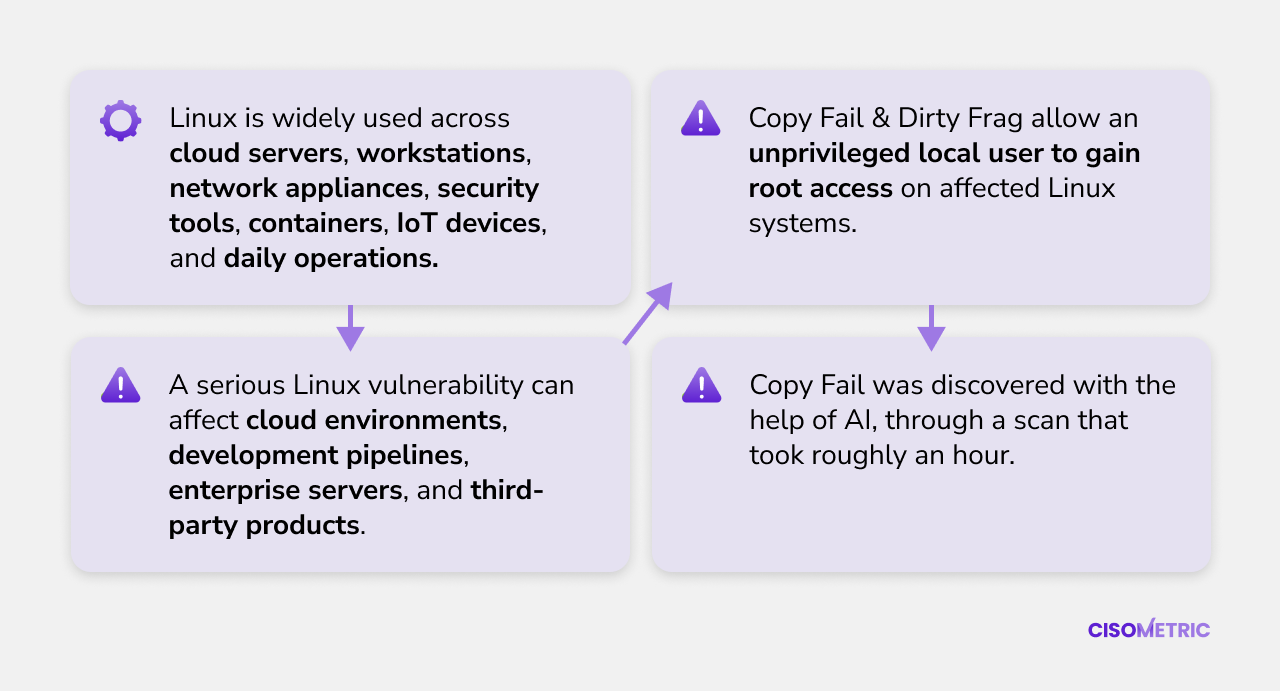
This year, several Linux kernel vulnerabilities brought this issue back into focus.
The most widely discussed were Copy Fail and Dirty Frag, both of which allow local privilege escalation on affected Linux systems.
Copy Fail refers to CVE-2026-31431, while Dirty Frag refers to an exploit chain involving CVE-2026-43284 and CVE-2026-43500. These vulnerabilities allow an unprivileged local user to gain root access, which is the highest level of control on a Linux system. These CVEs are considered reliably exploitable across major Linux distributions, creating broad exposure for organizations that depend on Linux-based infrastructure (Greenbone, 2026).
The case became even more notable because Copy Fail was discovered with the help of AI. Theori used its AI-powered security tool, Xint Code, to scan the Linux crypto/ subsystem. According to InfoQ, the scan took roughly an hour, used a single operator prompt, and did not require a custom harness (InfoQ, 2026).
This case shows how AI can accelerate vulnerability discovery. It also highlights why organizations need stronger visibility, faster response processes, and continuous monitoring across their infrastructure.
What Happened with Copy Fail and Dirty Frag?
Copy Fail was publicly disclosed on April 29, 2026, after being privately reported to the Linux kernel security team in March. The vulnerability was introduced through an in-place optimization in the Linux kernel’s algif_aead module in 2017.
The flaw allows an unprivileged process to perform a small write into the page cache of a file it does not own. In practical exploitation scenarios, this can be used to corrupt an in-memory version of a protected file, such as a setuid binary, and gain root privileges (Secure.com, 2026).
Shortly after Copy Fail, researcher Hyunwoo Kim published Dirty Frag.
Dirty Frag is a related vulnerability chain that combines two separate issues: one affecting the xfrm-ESP path and another affecting RxRPC. Together, the two issues cover a wider range of Linux configurations because each component compensates for the limitations of the other (Automox, 2026).
Dirty Frag was especially challenging for defenders because its proof-of-concept became public before distribution backports were fully in place. Automox noted that many teams had already deployed a Copy Fail mitigation by blacklisting algif_aead, but that mitigation did not stop Dirty Frag.
What Makes These Linux Vulnerabilities Important?
Copy Fail and Dirty Frag are local privilege escalation vulnerabilities. They do not typically provide remote access by themselves. An attacker would usually need an initial foothold on the system first.
Attackers often gain initial access through phishing, stolen credentials, exposed services, misconfigured applications, vulnerable software, or compromised third-party access. Once inside, a local privilege escalation vulnerability can help them move from limited access to root-level control.
These vulnerabilities are privilege-escalation accelerants. They may not be the initial entry point, but they can help an attacker turn low-privilege access into full administrative control much faster (Huntress, 2026).
Once root access is obtained, an attacker may be able to install malware, disable security tools, access sensitive data, create persistence, move laterally, or prepare the environment for ransomware activity. They can cause potential impacts such as credential theft, rootkit deployment, lateral movement, and downstream supply chain compromise.
For businesses, the main concern is not only the vulnerability itself, but how quickly it can be used after an attacker gains access.
Why Did These Bugs Stay Hidden for So Long?
Copy Fail and Dirty Frag are part of a broader class of Linux kernel issues involving page-cache writes and zero-copy functionality.
The page cache is used by the operating system to store recently accessed file data in memory. This improves performance because the system can read data from memory instead of repeatedly accessing the disk.
Zero-copy mechanisms are also designed for performance. Instead of repeatedly copying data between memory buffers, the system can pass references to existing memory. This helps reduce CPU overhead and improve throughput.
The security issue appears when these performance mechanisms interact in unexpected ways. In this bug class, kernel subsystems may perform an in-place write to memory that references the page cache. As a result, a file’s in-memory version can be modified even if the attacker only has read access to the original file (Huntress, 2026; Automox, 2026).
This is why the vulnerabilities are difficult to detect through some traditional methods. The file on disk may remain unchanged, while the version in memory is corrupted. It was reported that in Copy Fail exploitation, the on-disk file remains untouched, which can cause checksum-based file integrity tools to miss the modification (Secure.com, 2026).
These bugs also survived for years because they were not necessarily obvious in isolation. The affected areas were likely reviewed for their intended purposes, such as cryptographic correctness or protocol behavior, while the memory-write implications across subsystems were harder to identify through standard review processes.
The Role of AI in the Discovery
The AI function in this case is significant because it changes the economics of vulnerability discovery.
Copy Fail was found using Theori’s AI-powered Xint Code tool. The tool completed a targeted scan of the Linux crypto/ subsystem in about an hour (InfoQ, 2026).
This does not mean AI automatically replaces security researchers. Human expertise is still greatly needed to define scope, validate findings, understand exploitability, and responsibly disclose vulnerabilities. However, AI can help accelerate the discovery process by reviewing large and complex codebases faster than traditional manual approaches.
For defenders, this can be valuable. AI-assisted analysis may help researchers find hidden vulnerabilities sooner, especially in complex systems such as operating system kernels.
At the same time, the same acceleration can also benefit attackers. The speed-to-exploit window has become much shorter, with public proof-of-concept exploits and AI-assisted tooling reducing the time needed to weaponize newly disclosed vulnerabilities (Puppet, 2026).
For organizations, vulnerability management can no longer rely only on delayed, manual, or periodic response models. Patching remains essential, but it needs to be supported by accurate asset visibility, risk prioritization, mitigation planning, and continuous monitoring.
What Are the Risks for Organizations?
The business risk depends on where Linux is used in the environment and how quickly the organization can identify and secure affected systems.
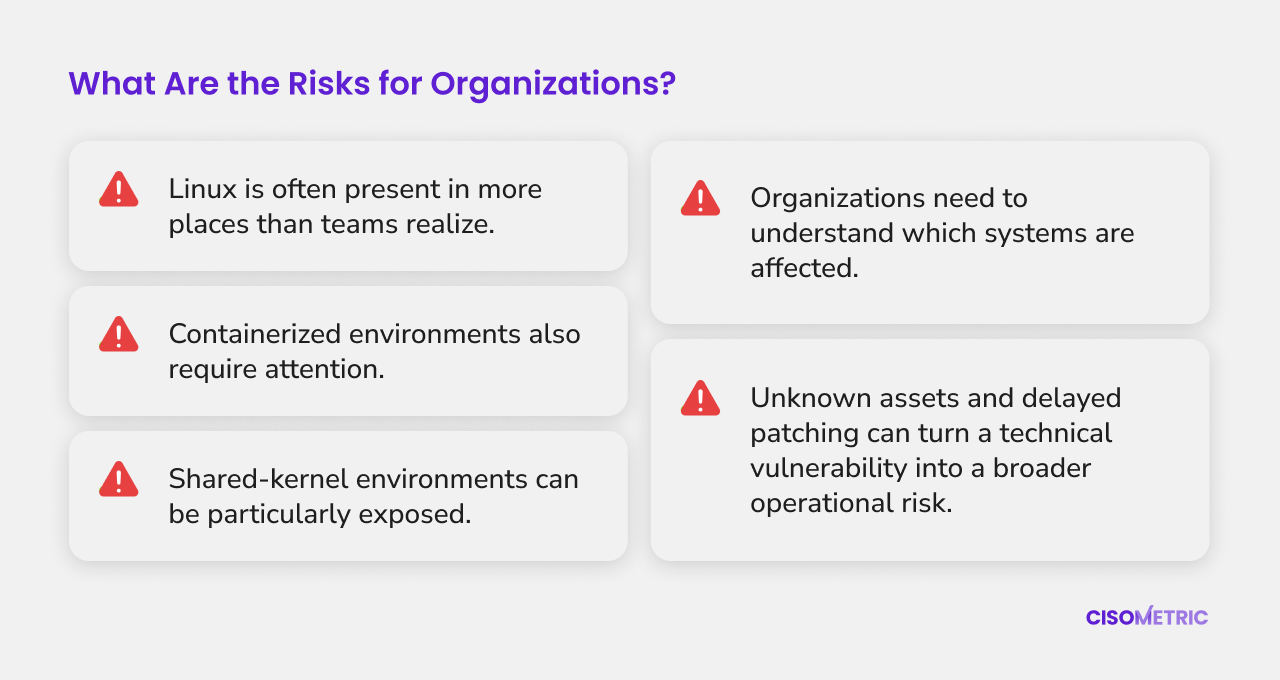
Linux is often present in more places than teams realize. It may exist in production servers, cloud workloads, container hosts, developer laptops, CI/CD runners, security appliances, IoT devices, and third-party products.
Copy Fail, Copy Fail 2, and Dirty Frag may introduce additional risk to third-party products that use Linux, making infrastructure-wide scanning important (Greenbone, 2026).
Containerized environments also require attention. Multi-tenant Kubernetes clusters, self-hosted CI/CD runners, and AI agent code-execution sandboxes can be particularly exposed because the page cache is shared across the host. In shared-kernel environments, a write from one container can affect other workloads on the same host.
This does not mean every Linux system will be exploited immediately. It means organizations need to understand which systems are affected, which systems are exposed to higher-risk access paths, and which workloads require faster mitigation.
The risk is higher when:
- Affected systems are unpatched
- Proof-of-concept exploit code is publicly available
- Attackers already have a local foothold
- Systems run shared-kernel workloads
- Security teams lack visibility into Linux assets
- Monitoring does not cover suspicious privilege escalation activity
- Third-party Linux-based products are not included in vulnerability assessment
For business leaders, this case reinforces the importance of maintaining a complete view of the IT environment. Unknown assets and delayed patching can turn a technical vulnerability into a broader operational risk.
What Are the Solutions?
Mitigation and Response
The most important long-term response is to apply kernel updates from official Linux distribution channels as soon as they are available. Patching is the most effective long-term fix.
When immediate patching is not possible, temporary mitigations may be considered. For Copy Fail, this may involve disabling the algif_aead kernel module. For Dirty Frag, mitigations may involve disabling modules such as esp4, esp6, and rxrpc, depending on the environment (Greenbone, 2026; Huntress, 2026; Automox, 2026).
These mitigations should be assessed carefully before implementation. Some affected modules may support legitimate business functions, such as IPsec VPN or RxRPC-dependent environments. Disabling them without proper evaluation may disrupt production systems.
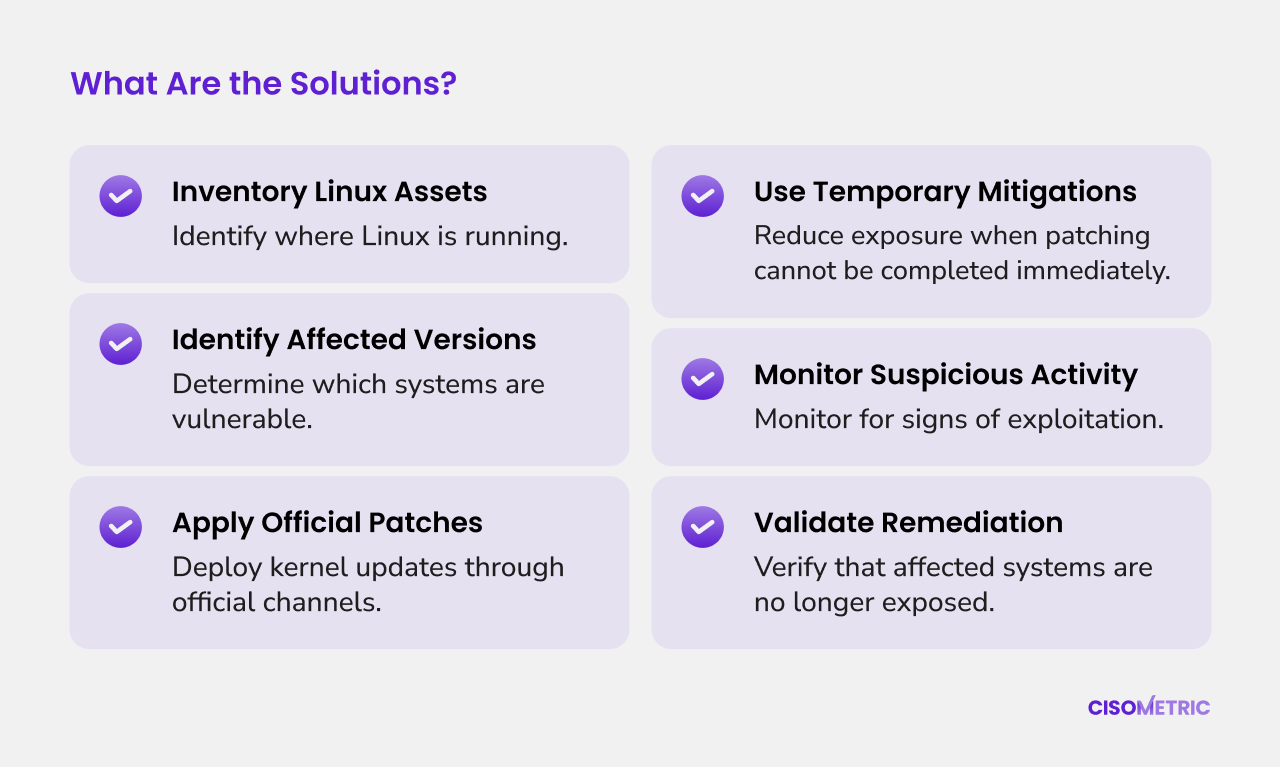
A structured response should include the following steps:
1. Inventory Linux assets across the environment
Organizations need to identify where Linux is running, including servers, cloud workloads, containers, developer machines, appliances, and third-party products.
2. Identify affected versions and configurations
Security teams should determine which systems are vulnerable, which modules are loaded, and which systems depend on affected functionality.
3. Apply official patches as soon as possible
Kernel updates should be deployed through official distribution channels, with proper testing and rollout planning to minimize operational disruption.
4. Use temporary mitigations where appropriate
Module blacklisting or namespace restrictions may reduce exposure when patching cannot be completed immediately, but they should be evaluated against business and technical dependencies.
5. Monitor for suspicious activity
Organizations should monitor for signs of exploitation, including anomalous setuid execution, unexpected root shell behavior, suspicious kernel-related calls, and indicators of page-cache contamination.
6. Validate remediation
After patching or mitigation, teams should verify that affected systems are no longer exposed and that new systems do not reintroduce the same risk.
Vulnerability Assessment and Penetration Testing (VAPT)
Copy Fail and Dirty Frag show why organizations need regular vulnerability assessment across their IT infrastructure.
Vulnerability assessment helps identify affected systems, missing patches, exposed services, and vulnerable third-party products. This is especially important for Linux environments because Linux may be present across multiple layers of the business, from cloud infrastructure to security appliances and embedded systems.
VAPT adds another layer of validation. It helps organizations understand whether identified weaknesses can be exploited in practical scenarios and how those weaknesses may affect business operations.
For vulnerabilities like Copy Fail and Dirty Frag, this distinction matters. A system may appear to be only moderately exposed at first, but if an attacker can use it to gain root access after obtaining a limited foothold, the risk becomes more serious.
Regular vulnerability assessment and VAPT help organizations move from reactive patching to a more proactive security process. They also support better prioritization, especially when multiple vulnerabilities, systems, and business dependencies need to be managed at the same time.
Security Operations Center (SOC) Monitoring
Patching and vulnerability assessment are essential, but they do not remove the need for continuous monitoring.
Some systems may remain exposed temporarily because patches are not yet available, compatibility testing is still ongoing, or third-party vendors have not released updates. In these situations, organizations need visibility into suspicious behavior across the environment.
An SOC helps monitor systems for indicators of compromise, abnormal privilege escalation, unusual process execution, suspicious access patterns, and activity that may indicate exploitation attempts.
This is important because Copy Fail and Dirty Frag may not always be detected through simple file-change monitoring. Some exploitation paths involve in-memory changes, meaning organizations need behavioral detection and security monitoring that can identify suspicious activity beyond static file integrity checks.
SOC monitoring helps reduce the time between suspicious activity and response. For organizations managing critical Linux workloads, that visibility can help contain threats before they expand into larger incidents.
What Businesses Should Learn from This Case
Copy Fail and Dirty Frag are a reminder that modern cybersecurity requires speed, visibility, and operational discipline. Several lessons can be taken from these discoveries:
- Long-hidden vulnerabilities can still exist in widely used and heavily reviewed systems. The fact that a bug has remained unnoticed for years does not make it harmless.
- AI-assisted security research can accelerate discovery. This creates opportunities for defenders, but it also shortens the response window when new vulnerabilities become public.
- Local privilege escalation vulnerabilities should not be underestimated. They may require prior access, but attackers often find that access through common methods such as phishing, stolen credentials, exposed applications, or misconfigurations.
- Patching alone is not enough if organizations do not know which systems need to be patched. Asset visibility, vulnerability scanning, prioritization, and validation are all part of the response.
- Monitoring remains critical. When public proof-of-concept code is available and exploitation can happen quickly, organizations need the ability to detect suspicious activity while remediation is still in progress.
Conclusion
Copy Fail and Dirty Frag show how quickly a hidden vulnerability can become an urgent security concern.
A flaw introduced years ago can remain unnoticed in a core system. AI-assisted research can help uncover it faster. Public proof-of-concept code can increase exposure. Attackers with existing access can use local privilege escalation to gain deeper control.
For organizations, the right response is readiness.
Businesses need to continuously assess their infrastructure, apply security updates quickly, validate exposure through vulnerability assessment and VAPT, evaluate temporary mitigations carefully, and monitor systems for signs of compromise.
Through Vulnerability Assessment and Penetration Testing (VAPT), Cisometric helps organizations identify, assess, and validate security gaps across their IT infrastructure before attackers can take advantage of them.
Through Cisometric’s Security Operations Center (SOC), organizations can strengthen continuous monitoring, detect suspicious activity, and respond faster when threats attempt to exploit vulnerable systems.
Copy Fail and Dirty Frag may be Linux vulnerabilities, but the larger lesson applies to every organization, that hidden risks can exist across the infrastructure, and they need to be found, prioritized, and addressed before they become incidents.
With the right assessment, monitoring, and response capabilities, organizations can strengthen their security posture and reduce the risk of small vulnerabilities turning into major business disruptions.
For more updates on cybersecurity insights, follow our social media:
LinkedIn: Cisometric
Instagram: @cisometric
Youtube: @Cisometric