

By Patricia A. Pramono • Studio 1080, Published on March 10, 2026
TABLE OF CONTENTS
In regulated industries, IT audits are a routine and necessary part of governance. They support compliance requirements, strengthen internal controls, and provide assurance to regulators, customers, and boards.
However, one critical aspect of the audit process is often underestimated, which is the report itself.
Organizations invest time and resources into audit fieldwork, interviews, testing, and evidence collection. Yet when the final report is reviewed during a regulatory examination or external audit, questions sometimes emerge, such as:
- What framework or criteria was this assessment mapped against?
- How were risks prioritized and rated?
- Where is the structured management response?
- What is the overall assurance conclusion?
At that stage, the issue is rarely the audit activity itself. The issue is whether the reporting meets professional and regulatory expectations.
In regulated environments, an IT audit report is more than a summary of findings. It becomes formal evidence of governance and control effectiveness. If the reporting structure lacks clarity, defensibility, or alignment with recognized standards, the organization may face unnecessary scrutiny.
Understanding IT Audits
Before discussing reporting standards, it is important to clarify what an IT audit actually is.
An IT audit is a structured and independent assessment of an organization’s information systems, controls, and related processes. Its purpose is to evaluate whether IT governance, security controls, risk management practices, and operational procedures are designed appropriately and functioning effectively (Imarticus Learning, 2025).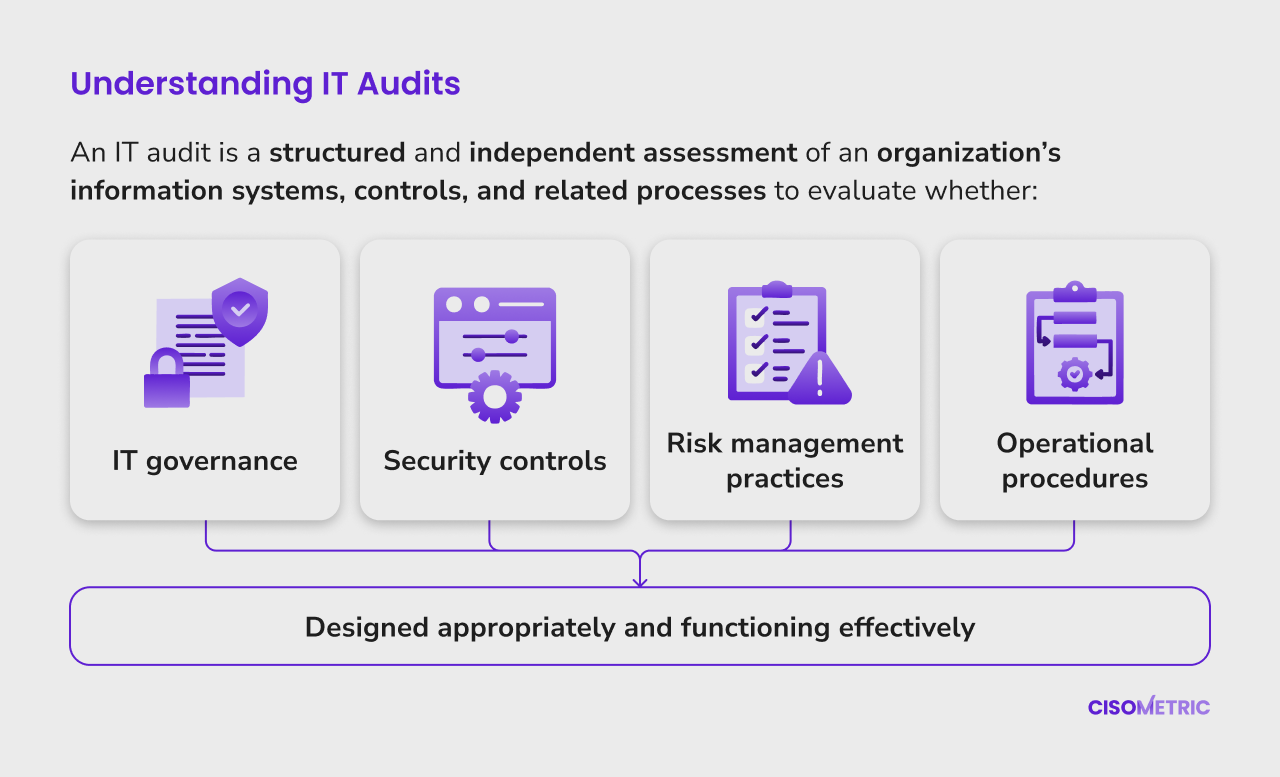
Depending on scope, an IT audit may assess:
- IT governance and oversight structures
- Access controls and identity management
- Change management processes
- System security configurations
- Disaster recovery and business continuity planning
- Data management lifecycle and protection controls
In practical terms, an IT audit examines whether the organization’s technology environment supports business objectives while complying with regulatory and policy requirements.
Effective IT audits help organizations (Virima, 2025):
- Ensure regulatory compliance
- Identify risks early
- Improve overall security posture
- Optimize IT operations
- Strengthen stakeholder trust
- Support informed decision-making
These outcomes extend beyond regulatory alignment. They influence operational continuity, risk management maturity, and executive oversight.
However, the strategic value of an IT audit does not arise merely from performing testing procedures. It materializes when the results are translated into structured, defensible, and actionable reporting.
What Is an IT Audit Report?
An audit report is a formal document that communicates the findings and conclusions of an audit engagement. It outlines the scope, methodology, evidence gathered, and the auditor’s opinion or conclusion (Imarticus Learning, 2025).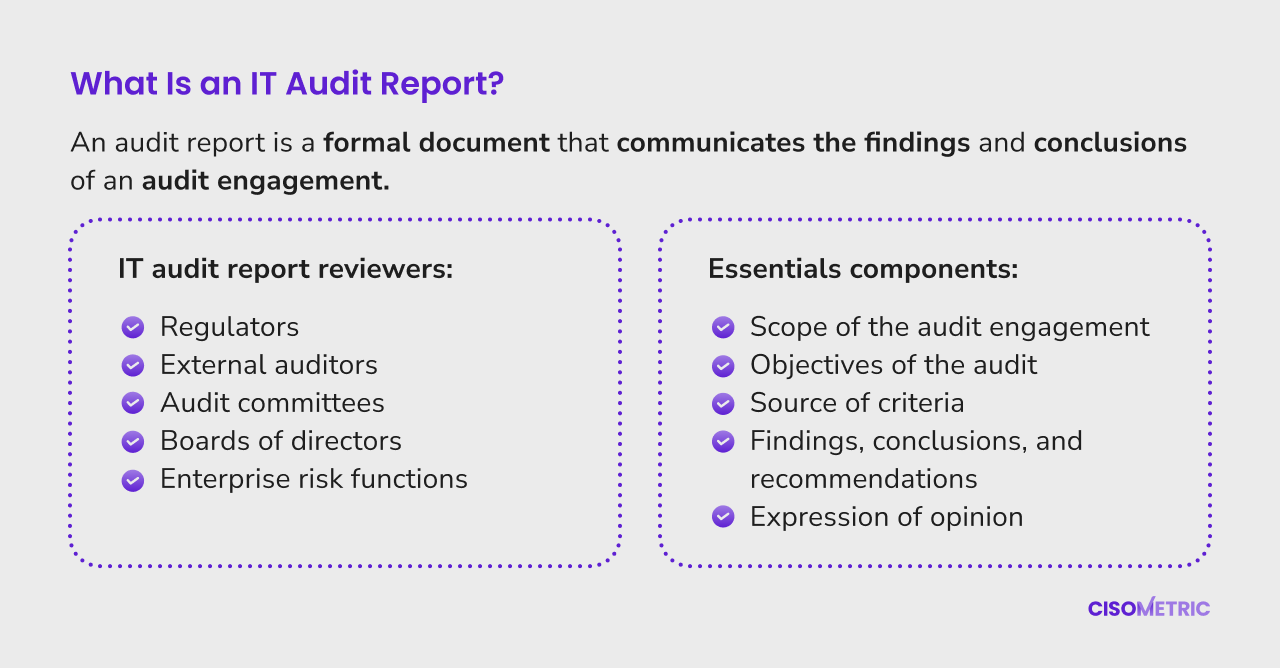
In the context of IT audits, this document may be reviewed by:
- Regulators
- External auditors
- Audit committees
- Boards of directors
- Enterprise risk functions
Because of this, the report must satisfy both technical and governance expectations. IT audit reports should clearly articulate (ISACA, 2020):
- Scope of the audit engagement
- Objectives of the audit
- Source of criteria
- Findings, conclusions, and recommendations
- Expression of opinion (where applicable)
Without these components, even well-executed audits may fail to demonstrate adequate assurance.
Why Reporting Standards Matter in Regulated Industries
Regulated industries operate under heightened expectations of accountability and transparency. IT audit reports often become part of the organization’s compliance narrative.
Weak reporting structures can create several risks:
- Ambiguity around control evaluation criteria
- Inconsistent risk prioritization
- Misalignment between findings and business objectives
- Lack of formal remediation tracking
Effective audit reporting is not simply about documenting testing activities. It is about communicating findings in a way that supports decision-making, strengthens relationships with leadership, and provides strategic influence (AuditBoard, 2026).
When reporting fails to align with professional standards, it may:
- Be challenged during regulatory reviews
- Require rework before external audits
- Delay remediation
- Reduce executive confidence in audit functions
In regulated environments, clarity and structure are governance requirements.
Common Weaknesses in IT Audit Reporting
Even when audit testing is competently performed, reporting weaknesses often emerge in predictable ways.
1. Lack of defined criteria
Reports sometimes fail to explicitly identify the benchmark used for evaluation. Audit criteria, whether regulatory standards, policies, or frameworks, must be clearly identified to ensure defensibility.
Without defined criteria, findings become subjective rather than objective.
2. Excessive technical language
Limiting unnecessary technical jargon in audit reports is advised. Overly technical descriptions can obscure the core message and reduce executive comprehension.
Reports must communicate business impact, not just technical conditions.
3. Absence of risk-based context
Findings presented without prioritization reduce clarity. Effective reporting places issues in risk context, linking them directly to business objectives.
When everything appears equally important, remediation efforts lose focus.
4. Weak issue structure
The widely adopted “5 C’s” structure in issue writing include (AuditBoard, 2026):
- Criteria
- Condition
- Cause
- Consequence
- Corrective action
This format strengthens clarity and reduces ambiguity in stakeholder discussions.
5. Missing management response
Incorporating management representation and response within the audit report is highly important. Without documented ownership and timelines, findings remain advisory rather than actionable.
In regulated industries, remediation tracking is essential.
Core Elements of a High-Impact IT Audit Report
Drawing from recognized audit guidance, defensible IT audit reports typically include (ISACA, 2020; AuditBoard, 2026; Imarticus Learning, 2025):
- Executive Summary
- Scope and Objectives
- Methodology Overview
- Source of Criteria
- Risk-Rated Findings
- Structured Recommendations
- Management Response
- Overall Conclusion or Opinion
Well-structured audit reports enhance transparency, accountability, and stakeholder confidence (Imarticus Learning, 2025). When these elements are present, audit reports move beyond compliance documentation and become governance tools.
IT audit reporting should align with established professional guidance.
ISACA’s IT Assurance Framework (ITAF) provides structured guidance on mandatory reporting components for IT audit engagements (ISACA, 2020). Similarly, audit reporting best practices outlined by AuditBoard (2026) also stress:
- Executive-focused summaries
- Clear linkage between findings and business objectives
- Risk-based prioritization
- Structured and consistent issue writing
Adhering to these principles enhances credibility and strengthens regulatory resilience.
Conclusion
An IT audit may be technically rigorous, but its governance value depends on how clearly its conclusions are communicated.
In regulated industries, audit reports are reviewed by regulators, external auditors, boards, and risk committees. They influence remediation priorities, resource allocation, and governance decisions. When reporting lacks structure or alignment to recognized standards, even well-performed audits may fail to demonstrate adequate assurance.
At Cisometric, IT audit reporting is treated as a core assurance deliverable. Reporting frameworks are aligned with recognized audit guidance, incorporate risk-based context and executive clarity, and include structured findings with remediation tracking to support governance oversight.
The objective is to produce reports that are clear for leadership, actionable for management, and defensible under regulatory scrutiny.
This approach is reflected in the experience of our clients.
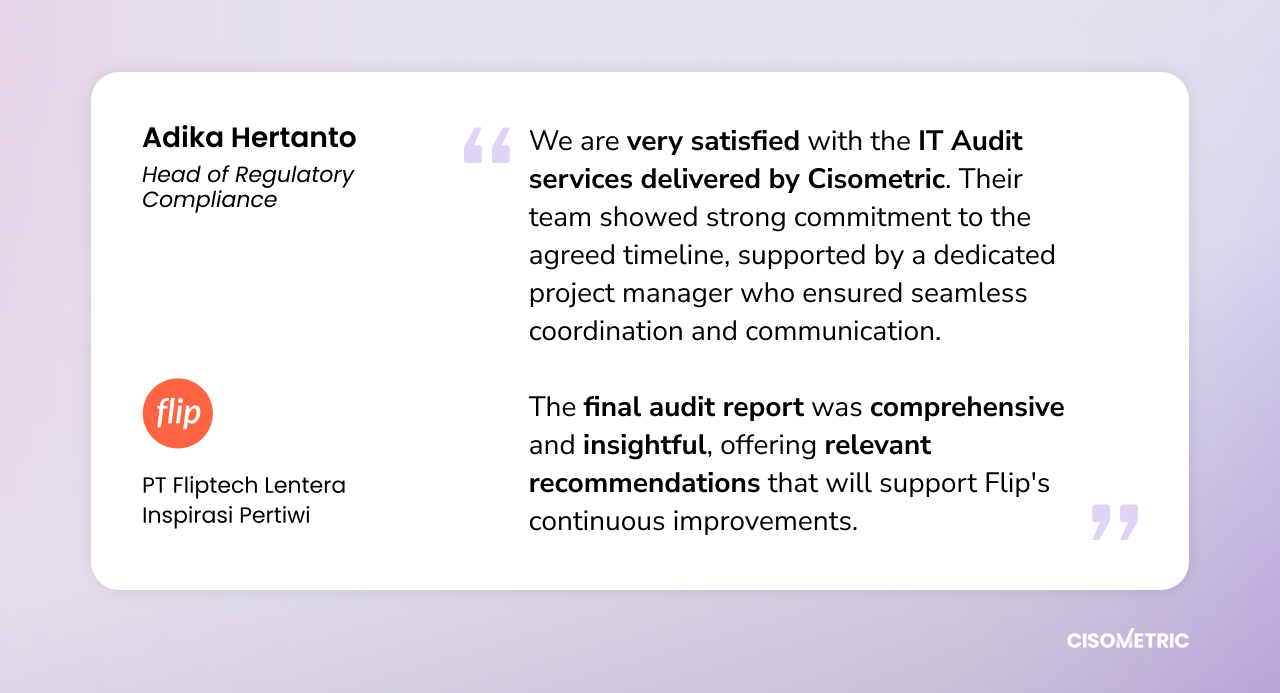
Flip, through its Head of Regulatory Compliance, Adika Hertanto, shared:
“We are very satisfied with the IT Audit services delivered by Cisometric. Their team showed strong commitment to the agreed timeline, supported by a dedicated project manager who ensured seamless coordination and communication.
The final audit report was comprehensive and insightful, offering relevant recommendations that will support Flip's continuous improvements.”
Feedback such as this reinforces an important point: strong audit reporting is not only about meeting standards — it is about delivering clarity, structure, and meaningful recommendations that support continuous improvement.
In regulated environments, assurance must withstand examination. Reporting is where that assurance becomes visible.
Organizations seeking to strengthen the defensibility and clarity of their IT audit reporting can benefit from a structured, standards-aligned approach. Engaging experienced audit professionals who understand both regulatory expectations and governance requirements ensures that audit outputs support not only compliance, but long-term control maturity.
Schedule a free consultation with our experts today, click here.
For more updates on digital scams, cybersecurity insights, and expert tips, follow our social media:
LinkedIn: Cisometric
Instagram: @cisometric
Youtube: @Cisometric
Reference:
What makes an IT audit successful: Key points to consider
Audit reporting best practices: Guide for audit leaders
The Different Types of Audit Reports and Reporting Protocols